- Brand Matters by Lento Agency
- Posts
- Beyond the Tote Bag: The New Rules for Sustainable Merch
Beyond the Tote Bag: The New Rules for Sustainable Merch
What happens when brands stop treating merchandise as "stuff with a logo" and start engineering products people actually keep

Jair Lucena
December 12, 2025 • Estimated Reading Time: 16 minutes

Hi there,
Welcome back to another week of Brand Matters.
If you're ordering branded merchandise this year, the old playbook is dead. This week, the new rules for sustainable merch—from lab-grown materials to killing the 5,000-unit minimum.
In today's issue:
Material innovation, local craft, and designing for daily life
Why on-demand production beats bulk orders
The CMO reality check: 6 rules that actually work
Ad of the Week: Uber Eats commits to the bit
Brand Watch: Bleume treats plant food like luxury
UK bans Nike, Superdry, and Lacoste for greenwashing
Let's get started.


There’s a better way. Athyna helps you build high-performing teams—fast, affordable, and without the hiring headaches.
Here’s how:
🤖 AI-powered matching connects you with talent tailored to your needs.
⚡ 4 days from brief to interviews.
💸 Save up to $60K per hire with top LATAM marketers.
Speed, precision, and serious savings—no compromises.
👉 Ready to change the way you hire?
Thank you for supporting our sponsors, who keep this newsletter free.
Walk into any coffee shop, conference, or client meeting in 2025 and you'll see it: the same canvas tote with a different logo slapped on. Undyed beige, minimalist wordmark, maybe a sustainability pun if the marketing team felt inspired.
You probably own several—the conference freebie, the client gift, the onboarding swag, plus a few you can't remember acquiring. They're stuffed in closets and folded under sinks, quietly accumulating.
The tote bag became sustainability's favorite accessory—ubiquitous, well-intentioned, and somehow the default answer to "what should we give people that shows we care about the planet?"
But here's the uncomfortable truth nobody mentions when ordering 5,000 units: studies suggest you need to use an organic cotton tote roughly 20,000 times to offset the water consumed during production. Twenty thousand times. Unless you plan to pass that conference bag down to your grandchildren as a family heirloom (which, let's be honest, they don't want), it's not an environmental solution. It's just a very thirsty bag.
Sustainability isn't a buzzword anymore—it's the baseline. The real question isn't whether you're talking about it. It's whether you're actually moving the needle, or just swapping one kind of clutter for another.

The Greenwashing Trap
If you think sustainability is still a "nice to have," try talking to anyone under 40. Gen Z isn't just aware of climate change—they're actively hostile toward brands that treat it as a marketing aesthetic.
We saw this at Cannes this year. The "Nature Saves Britannia" campaign was designed to be a triumph—a celebration of small, sustainable steps that won awards, looked beautiful, and made everyone in the jury room feel fantastic. But the applause hadn't even died down before the narrative collapsed. When critics like Polina Zabrodskaya examined the receipts, they discovered Britannia's own data showed rising water use and emissions.
The campaign wasn't leadership. It was a carefully-constructed trap.
Britannia's not alone. The Changing Markets Foundation found that roughly 60% of sustainability claims in fashion are unsubstantiated or misleading. Shein got fined €1 million for greenwashing. The UK now empowers fines up to 10% of global turnover for similar violations.
Then there's H&M. 96% of their environmental claims were questionable. That's not a margin of error—that's a business model. For you as a brand manager, this is the nightmare: ordering 10,000 units of merchandise to look good, only to become the villain in a viral video essay about corporate hypocrisy.
The Tote Bag Paradox: Avoiding the Closet of Shame
For too long, the industry believed more swag meant more impact. But flooding the world with "eco" merch isn't progress—it's clutter, waste, and deeper skepticism.
Consider the actual lifecycle: You order 5,000 tote bags at $9.40 each—total spend of $47,000. All organic cotton, properly certified, sustainability box checked. Six months later, maybe 200 are still in regular use. The rest sit in closets, landfills, or thrift stores.
Your cost per meaningful impression? $235.
The math is brutal, but it reveals something important: volume isn't a strategy. The most sustainable product is the one you didn't make. The second most sustainable? The one someone actually keeps.
Sometimes the smartest sustainability move is killing the merchandise entirely. Forget the tote bags, the water bottles, the branded pens—invest in an experience that actually matters. A workshop that transforms thinking. A digital platform that connects people. An initiative that solves a real problem instead of creating branded landfill.
But let's be honest: most of you reading this have already decided you need to make something. Conference sponsorship requires it. Client expectations demand it. Employee onboarding includes it. The question isn't whether to make merchandise—it's how to make it matter.
If that's where you are, here's what's actually working.
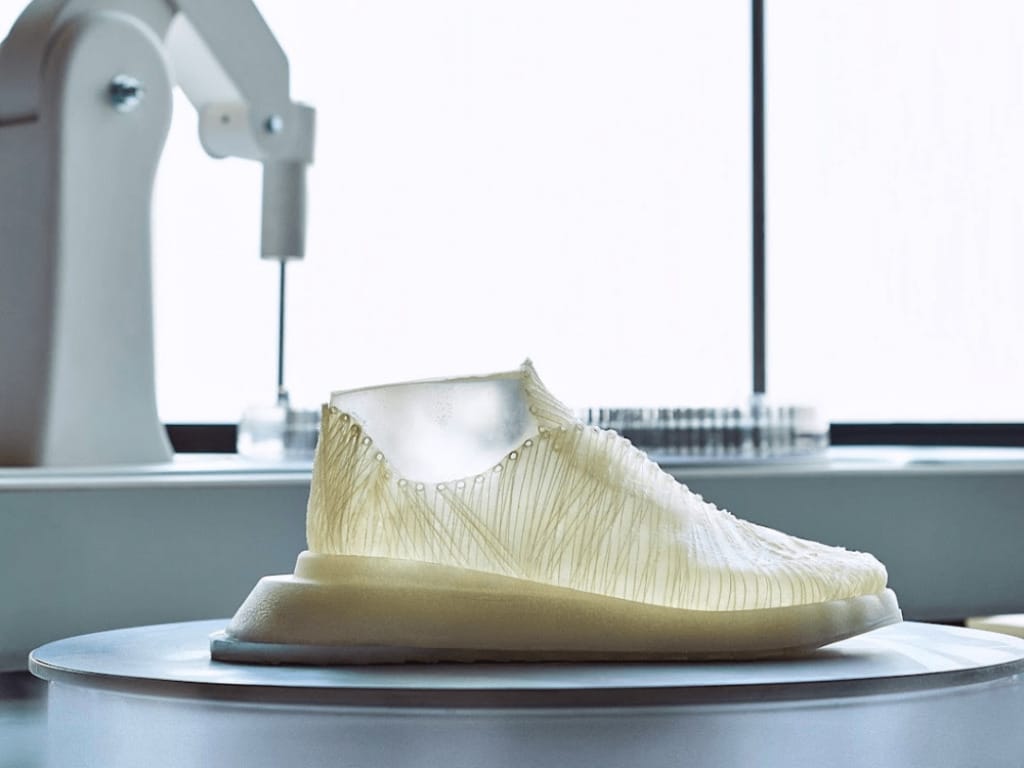
Modern Synthesis uses bacteria to convert sugars found in agricultural waste into a weaveable nanocellulose material
What's Actually Working: A Field Guide
The brands making real progress have stopped treating merchandise as "stuff with a logo on it" and started approaching it like product engineering.
Material Innovation: From Lab to Luxury
The era of swapping plastic for bamboo—just trading one disposable material for another—is fading. The real shift is happening at the molecular level.
Mycelium leather: Ganni and Modern Synthesis have prototyped fully biofabricated bags grown in labs instead of stripped from animals. It's material innovation that makes you rethink what "manufacturing" even means.
Waste becomes supply: Notpla replaces plastic with seaweed packaging that dissolves in weeks rather than lingering for 400 years. The most sustainable sourcing strategy might just be cleaning up someone else's mess.
A polyester shirt is just a shirt. But a bag made from lab-grown, plastic-free bio-leather? That's a conversation starter. That's an artifact.
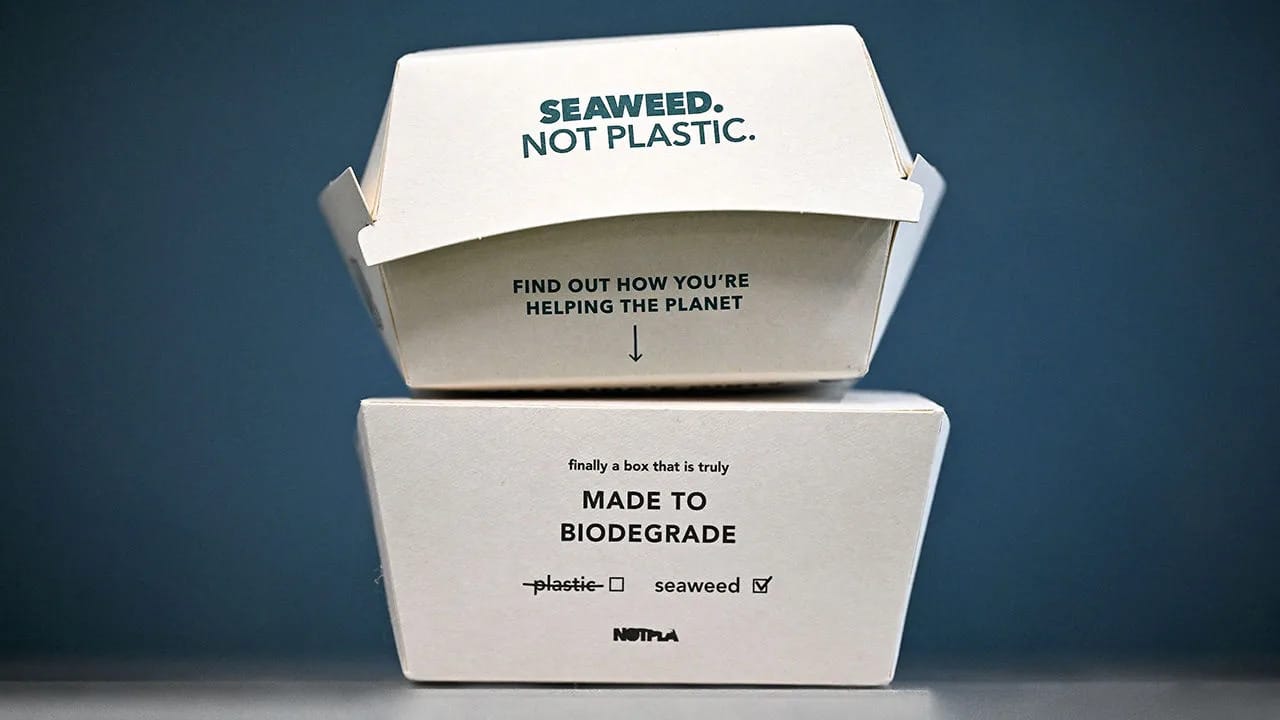
Notpla seaweed packaging
Craft Over Commodity: The Local Partnership Model
Instead of mass-producing generic swag, the smartest brands partner with:
Local ceramists for hand-thrown mugs
Neighborhood bookbinders for custom notebooks
Community artisans who create objects with provenance
You're not just reducing shipping emissions—you're creating things people treasure instead of donate within months. People keep objects with stories.
Utility Engineering: Design for Daily Life
The best sustainable merch isn't "eco-friendly"—it's habit-changing.
Glass storage containers that eliminate single-use packaging and encourage bulk buying
Modular lunch systems (like Porter's leak-proof designs) that replace years of takeout waste
Klean Kanteen's B Corp-certified bottles where every component can be replaced individually
There's a massive difference between a cheap "eco" pen that breaks in three days and a well-engineered object that survives five years of daily use. When merchandise integrates into someone's life, the carbon footprint amortizes over hundreds of uses.
Rethinking Volume: On-Demand Over Overproduction
The most sophisticated brands have stopped ordering 5,000 units of anything. They're piloting on-demand production—custom runs, zero waste, full traceability.
When you're not locked into massive minimums, when you can test with 50 and scale only if there's demand, you can afford to make better things because you're making fewer of them. Overproduction has always been the industry's original sin. Now the technology exists to end it.
The Cost Question
Let's address the obvious. Yes, this costs more per unit. A mycelium leather portfolio runs 3-4x what you'd pay for standard synthetic. Modular construction adds complexity. Third-party certifications aren't free.
So let’s now break it down a bit further. When you order 200 exceptional items people actually use versus 5,000 mediocre ones gathering dust in closets, your cost per meaningful brand interaction plummets. Add in the PR value of genuine innovation—instead of defensively explaining your greenwashing—and the premium pays for itself.
You're not spending more. You're spending smarter.
The CMO's Reality Check
Question the brief. Before ordering anything, ask: Could this goal be achieved without physical merchandise? Sometimes the best sustainability move is investing in an experience, a donation, or expertise instead of more stuff.
Demand proof, not promises. If your supplier can't provide third-party certifications (B Corp, GOTS, Bluesign, Fair Trade), walk away. The supply chain black box is dead.
Design for daily life. If your merch isn't built for years of actual use, it's destined for the landfill. Ask: Will this survive daily use for 5+ years, or just the flight home?
Partner with craft, not catalogs. Work with local makers who can create objects people treasure. A hand-thrown mug from a neighborhood ceramist beats 1,000 generic mugs from a catalog every time.
Kill the minimum order. Use on-demand production to test with 50 units before committing to 5,000. When you're not locked into massive minimums, you can afford to make better things because you're making fewer of them.
Practice radical honesty. Don't project perfection. The brands that win invite their audience into the complexity—showing concrete progress while acknowledging the work ahead.
The next headline could spotlight your breakthrough or expose your blind spot. The difference comes down to rigor, receipts, and accountability.
What's Next
By 2030, digital product passports will be standard in Europe—blockchain-backed tracking from raw material through disposal. Once they're mandatory in major markets, everywhere else follows. Meanwhile, biomaterials are moving from research labs to production floors. The gap between "interesting science project" and "you can order this now" is closing fast.
Right now, most corporate gift boxes contain the same forgettable tote bags they always have. The same beige canvas. The same good intentions. The same closet where they'll spend years unworn.
You can be different.
You can order 200 things people actually want instead of 5,000 things they toss in a drawer and forget. You can show up with merchandise so well-designed, so genuinely useful, so transparently sourced that people ask where you found it. You can turn branded merchandise from a budget line item into a competitive advantage.
The future of sustainable merch isn't about finding cheaper organic cotton. It's about rethinking value from the ground up—choosing craft over volume, utility over "awareness," and radical transparency over plausible deniability.
The most valuable thing you can put your logo on isn't a tote bag. It's a standard.
That standard starts with your next order.
How did you rate this read? |

Ad of the Week: Uber Eats
Uber Eats' latest spots from Special US take the "Get Almost, Almost Anything" platform and push it somewhere genuinely strange. A couple doing an awkward Latin dance becomes "mild salsa." A guy in a banana costume sprinting toward someone dressed as a grape? "Passion fruit."
It's visual dad jokes brought to life by director Nick Ball through MJZ, and the genius is in committing so completely to the absurdity that the groaning becomes the point. Most delivery platforms hammer you with speed and convenience. Uber Eats figured out they could do that while also having produce-themed people express deep emotion.
Sometimes the best advertising doesn't try to be clever. It just commits fully to being weird and trusts people will either get it or won't.
Brand Watch: NKORA

Forner Studio took liquid fertilizer—a category that typically lives under the sink in utilitarian bottles—and made it something you'd display next to your succulents.
Bleume's identity centers on "the Bleume hour," their riff on the blue hour when plants apparently do their most dramatic growing. The bottles carry that blue through with embossed foil details and elevated packaging that looks more like a skincare line than something you feed your fiddle leaf fig.
It's a textbook case of understanding that people who care about houseplants enough to buy premium fertilizer probably also care about what the bottle looks like sitting on their shelf. Most plant food brands treat the category like it's still 1987. Bleume treats it like the design-conscious consumers buying it actually exist.
The rebrand works because it doesn't oversell. No overwrought poetry about "nourishing living things." Just clean design that acknowledges houseplant people are often the same people who think about how things look in their space. Sometimes the insight is just noticing that obvious thing everyone else missed.
Lento Vibes
A bit of random inspo from around the grounds:
McDonald’s Pulls AI Christmas Ad: McDonald’s scraps an AI-generated Christmas spot after public backlash, reigniting the debate around generative creativity and brand trust. 👉 Read the story
Netflix Buys Big with WBD Deal: Netflix announces an $83B acquisition of Warner Bros. Discovery, reshaping the streaming wars and the future of global content power. 👉 What to know
Greenwashing Ads Banned in the UK: Nike, Superdry, and Lacoste ads are banned by UK regulators over misleading sustainability claims—raising the bar on green marketing. 👉 See the ruling
Disney Strikes AI Licensing Deal: Disney inks a licensing agreement with OpenAI, while Google issues cease-and-desist notices—signalling rising tension over AI training data. 👉 Read the update
Instagram Adds Chatbot to the Feed: Instagram begins testing a chatbot tied to its recommendation engine, blending AI assistance directly into content discovery. 👉 Explore the test

You can always reach me directly by emailing [email protected] or simply by replying to this email.
I’d love to hear your questions, thoughts, or any ideas you might have. Thanks again for subscribing! I’m stoked to see where this will take us.
 | Tom Mackay Let’s connect on Linkedin |